Most people applying to a newsroom tell you what they've read. I'll tell you what I noticed instead: that the sharpest geopolitical analysis in Indian media for the last decade has come not from legacy broadsheets or government-adjacent television, but from one woman with a camera, a script, and an opinion she wasn't afraid to finish. That's not flattery. That's just what the data says.
I'm an engineer by training — U.S. bachelor's of science in IST at Penn State with a 3.7/4.0 GPA, graduating this August, 130-odd credits across Computer Engineering, Applied Data Sciences, and Information Systems. ML pipelines, LLM-RAG architectures, cloud ETL, three internships in the U.S. The technology isn't decoration on my resume. It's the second language I think in. The first one was always news.
Here's the thing about data journalism that most newsrooms have figured out too late: the story isn't in the chart. The story is in what the chart makes undeniable. I built an analytical report you'll find below — India's fiscal federalism crisis, quantified, before submitting this application. Not as a portfolio exercise. As a point of view. It argues something. I'd be happy to defend it.
IGR is, at the time of writing, very new. In essence it is THE new age media startup, an environment where innovation, free thought and experimentation would reside and my critical thinking and creativity would thrive. The infrastructure a data-first newsroom needs doesn't get retrofitted. It gets built in the first few months, by whoever is in the room. Penn State's IST 495 framework gives me a 12-week window starting May, with full academic oversight, which handles the paperwork. I'd handle the rest.
I am not the applicant who has always wanted to work in media. I'm the one who has spent years building the tools that media needs and happens to have grown up reading newspapers at the breakfast table since grade three, treating every headline like a crime scene. That combination is either exactly what you're looking for, or it isn't. Either way, the work below makes the case better than this letter can.
The States That Pay vs. The States That Receive
¶Uttar Pradesh, with a GSDP roughly equal to Karnataka's, receives 4.9 times more central money. Not because it produces more. Not because it innovates more. But because it has more people, and in India's fiscal architecture, population is the formula that pays.
The 15th Finance Commission allocates 41% of the divisible tax pool to states. The formula weights population at 15%, demographic performance at 12.5%, area at 15%, and income distance at 45%. On paper, it looks redistributive and fair. In practice, it has created a machine that quietly punishes the states that did exactly what the Centre asked them to do: control their fertility, grow their economies, and build their own tax bases.
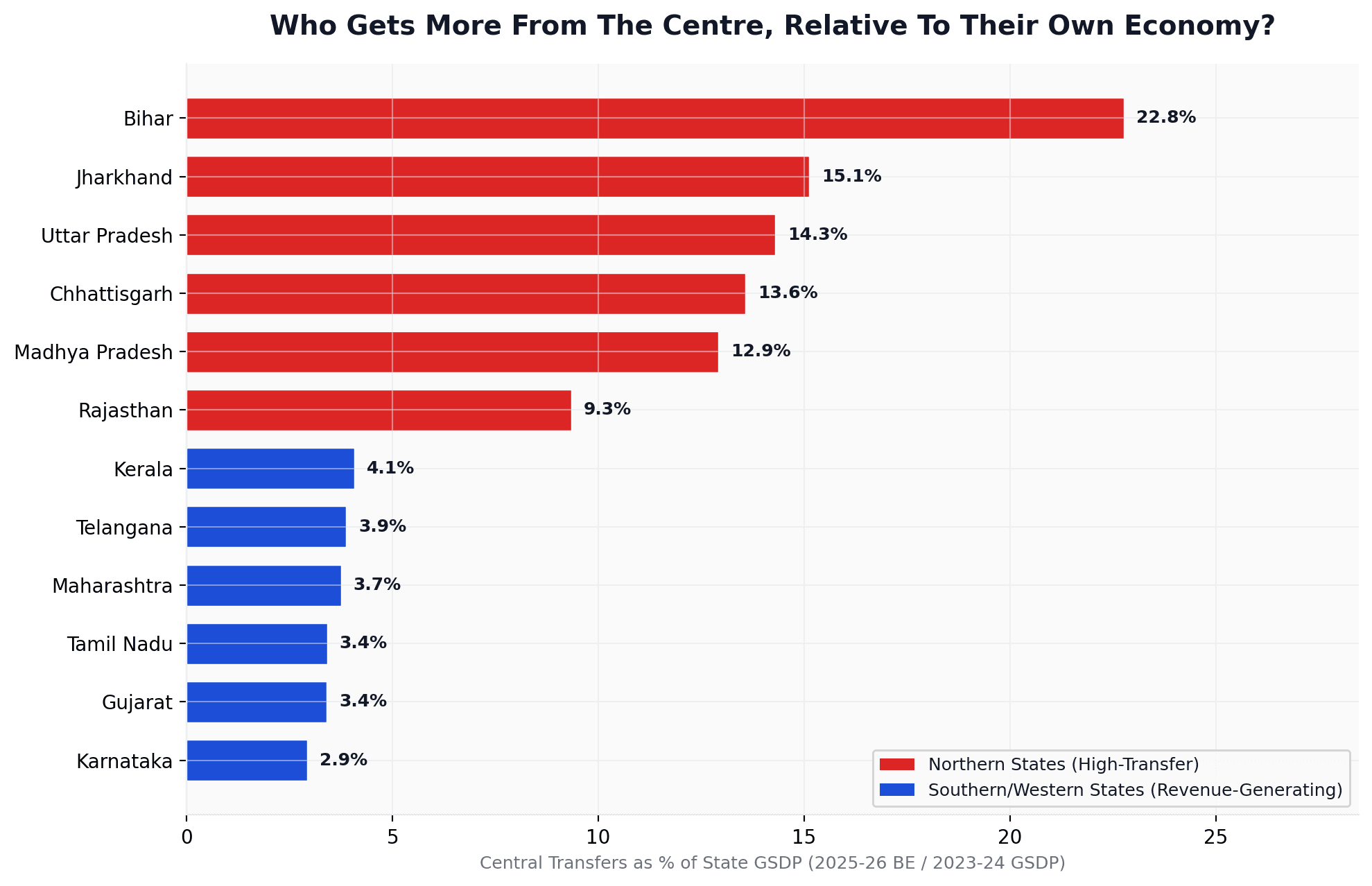
The data is unequivocal. Bihar receives central transfers worth 22.8% of its entire GSDP, nearly a quarter of its economy is simply handed down from New Delhi. Karnataka? 2.9%. Maharashtra, which generates the largest single-state contribution to India's direct tax pool? 3.7%. Tamil Nadu, Gujarat, Telangana — all clustered below 4%. These are not rounding errors. This is a structural transfer of wealth from states that generate revenue to states that generate votes.
The Demographic Trap
The divergence runs deeper than fiscal formulas. Plot the Total Fertility Rate against per-capita income across India's major states and a pattern emerges so stark it barely needs a regression line.
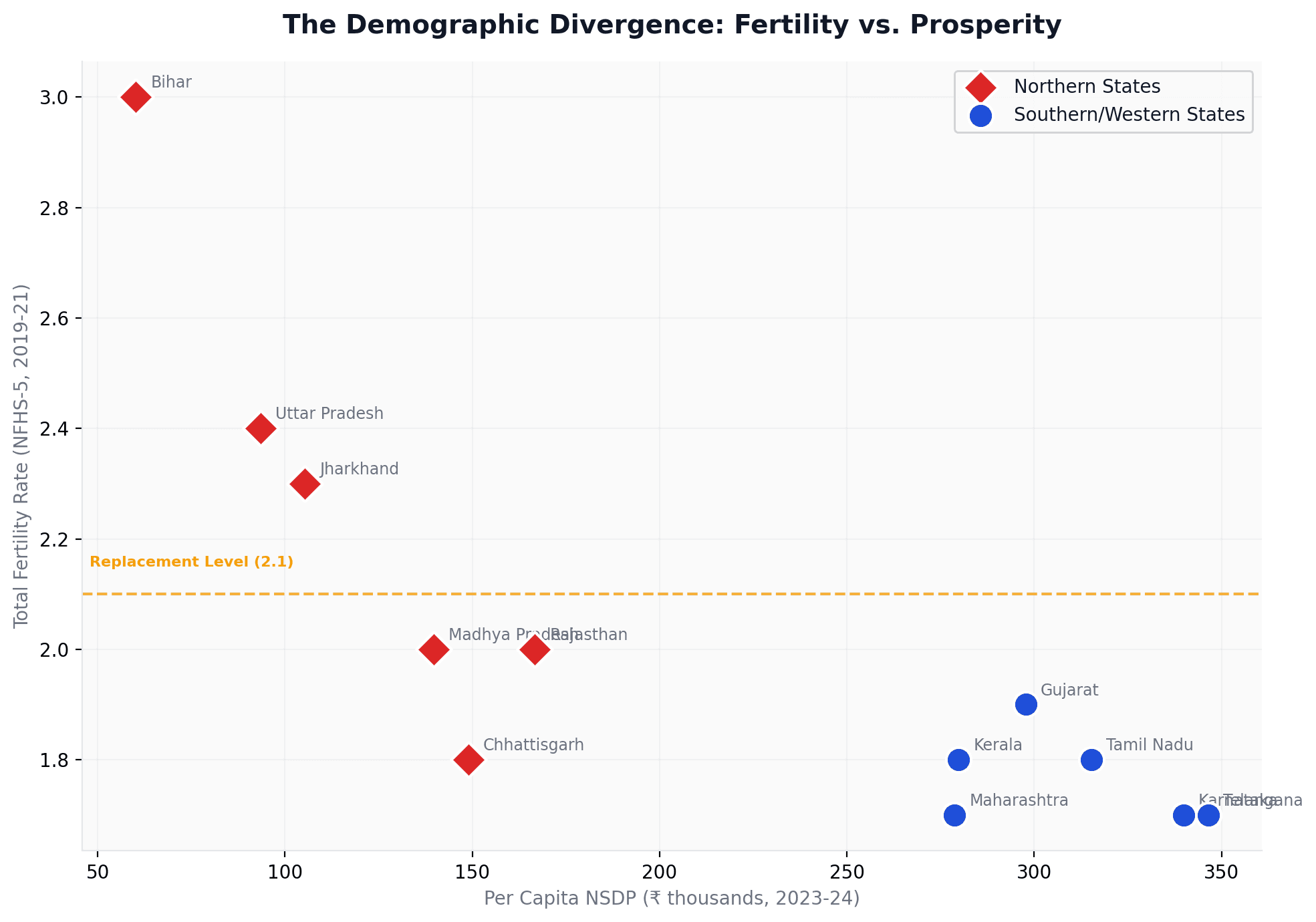
Northern states including Bihar (TFR 3.0), Uttar Pradesh (2.4), Jharkhand (2.3) sit in the upper-left quadrant. Southern and Western states - Karnataka, Telangana, Maharashtra (all 1.7), Tamil Nadu, Kerala (1.8) cluster in the lower-right. The average TFR of the Northern six is 2.25; the Southern/Western six average 1.77. One group is still adding people above replacement rate. The other stopped a generation ago.
This matters because the Finance Commission formula rewards population size. States that invested in education, women's empowerment, and family planning, the very policies Delhi's own planners championed, now find themselves fiscally penalised for their success. Every child not born in Tamil Nadu is a fraction of a percentage point lost in the next devolution formula. That is not a policy outcome. That is a perverse incentive encoded into the Constitution.
The Absolute Numbers
Strip away the ratios and look at the raw transfers. In the 2025-26 Union Budget, the six Northern states are budgeted to receive ₹10.17 lakh crore in central devolution and grants. The six Southern/Western states will receive ₹5.05 lakh crore. The Northern six get twice as much, despite producing half the economic output.
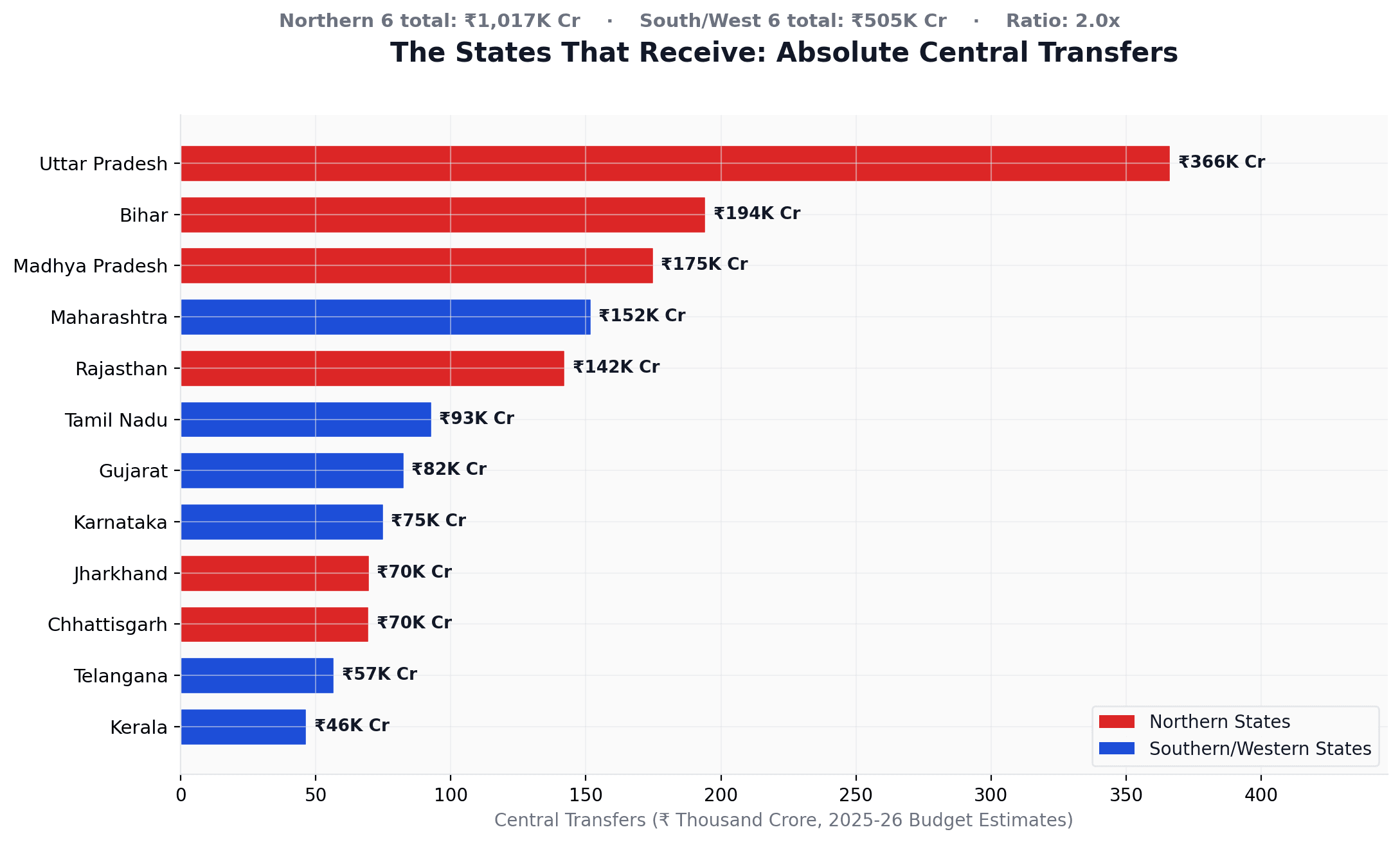
This is not an argument against redistribution. Every federal democracy transfers resources from richer to poorer regions. Germany does it. The United States does it. But in those systems, the transfer comes with convergence: poorer regions gradually catch up. In India, the data suggests something closer to dependence.
The Growth Question
If the transfers were working, if Bihar and UP were converging toward Maharashtra and Karnataka, the fiscal architecture would justify itself. But the growth trajectories tell a more complicated story.
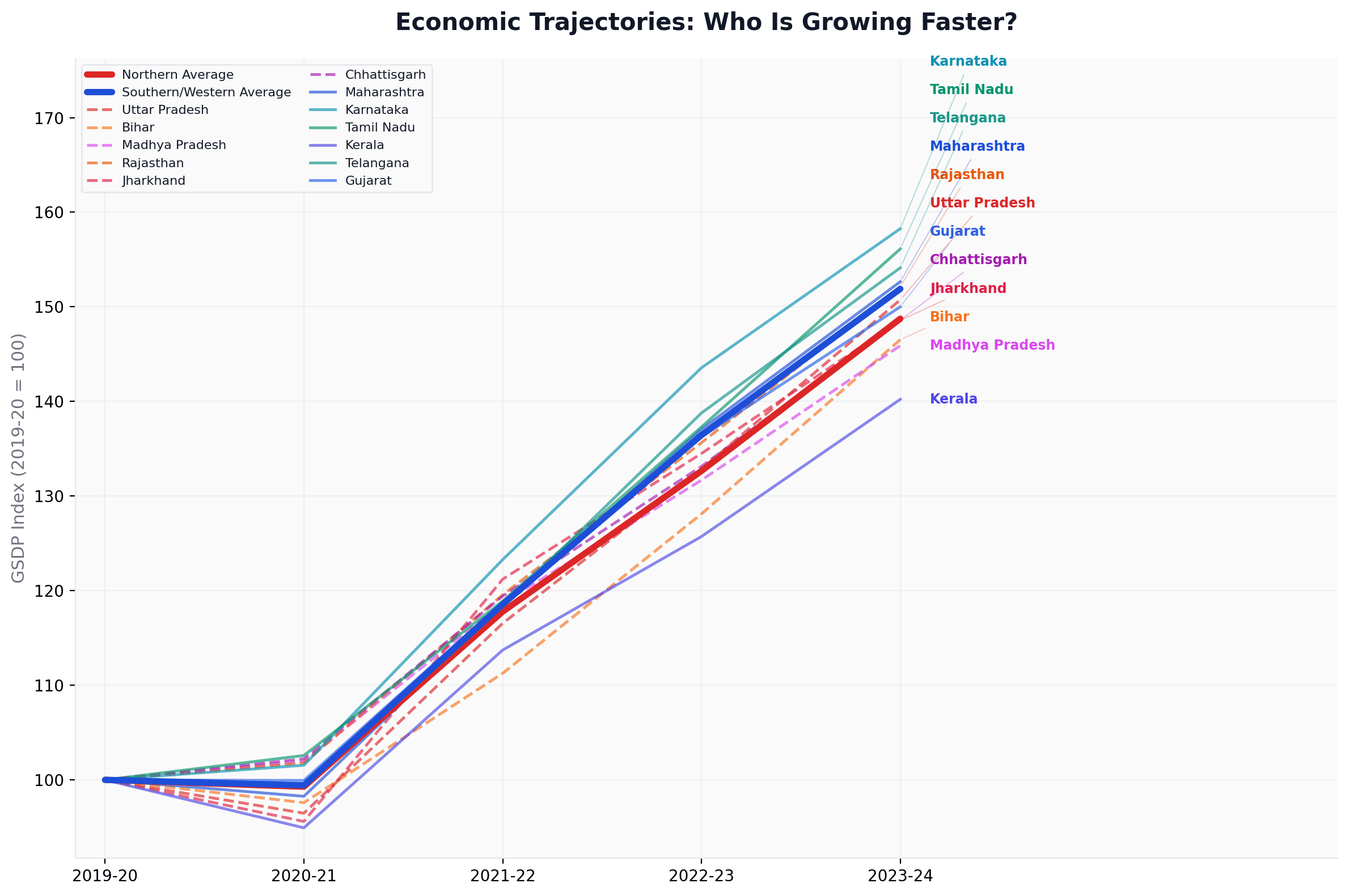
Karnataka's GSDP has expanded by over 55% in nominal terms; Bihar and Madhya Pradesh sit closer to 45%. The states receiving less from the Centre are not just richer, they are pulling further ahead. The transfers are not closing the gap. They are financing a parallel economy of welfare schemes, infrastructure deficits, and electoral expenditure that generates political returns without proportional economic convergence.
The Position
The 16th Finance Commission, chaired by Arvind Panagariya, will submit its report by October 2025 with recommendations effective from April 2026. It faces a choice that is ultimately political, not technical: continue a formula that rewards demographic expansion and penalises fiscal discipline, or restructure the compact to incentivise the outcomes India actually needs stable and distributed fertility, higher own-tax revenue, reduced borrowing, and genuine convergence.
The current architecture does not merely redistribute wealth. It redistributes incentives — in the wrong direction. States that built their own prosperity are asked to subsidise states that didn't, while receiving no mechanism to recoup, no timeline for convergence, and no accountability for outcomes. If this asymmetry is not addressed before the next Census reshapes parliamentary constituencies, the question will stop being fiscal and start being existential.
India's federal compact was designed for a young, growing, industrialising nation. The nation that exists today stands demographically split, economically divergent, and politically polarised along precisely these fault lines, needs a framework.
Data and analysis by Siddharth Shah. All datasets are publicly available from the RBI (State Finances 2025-26), MoSPI, and NFHS-5. Charts generated with Python (Pandas, Matplotlib). Methodology available on request.
The voices I was built by.
The shorthand for what kind of editorial mind I bring.
Fareed Zakaria
GPS, CNN
Christiane Amanpour
Amanpour, CNN
Sir Mark Tully
BBC, India
Prannoy Roy
NDTV
Vinod Dua
The Wire
Palki Sharma
India Global Review
Sudhir Chaudhary
Doordarshan
Rahul Kanwal
India Today
Jimmy Kimmel
Jimmy Kimmel Live!, ABC
Stephen Colbert
The Late Show, CBS
Know me better at siddharthgshah.com →